In organisations navigating growth, restructuring, digital transformation and changing workforce expectations, HR is increasingly expected to contribute directly to business performance.
Yet there remains a significant gap between the language of strategic HR and the capabilities required to practise it.
Many HR professionals aspire to become strategic business partners, but their day-to-day work remains largely transactional. They may understand HR processes thoroughly while having limited understanding of financial performance, business strategy, technology, data or the operating model of the organisation. Others may understand the business but struggle to translate that understanding into workforce strategy, organisation design or people decisions.
This distinction is particularly important for Africa's emerging generation of HR professionals. As organisations across the continent respond to technological change, increasingly complex labour markets, economic pressures and the adoption of artificial intelligence, the value of HR will depend less on its ability to administer established processes and more on its ability to anticipate organisational needs and shape the workforce required to meet them.
Recent global research reflects this shift. BCG's 2026 research with the World Federation of People Management Associations found that 65% of senior leaders surveyed regard HR as a key business enabler, while administrative workload remains a major barrier to HR's strategic contribution. The same research identifies delivering business value, leading digital and AI transformation, building workforce and leadership capabilities, and anchoring organisational change as central priorities for the function.
McKinsey's 2026 research makes a similar argument from another direction: workforce planning increasingly needs to move beyond short-term headcount planning towards strategic capability planning as automation and AI change the nature of work.
For African HR professionals, these developments should not be interpreted as a distant evolution taking place elsewhere. They are a signal of where the profession is heading.
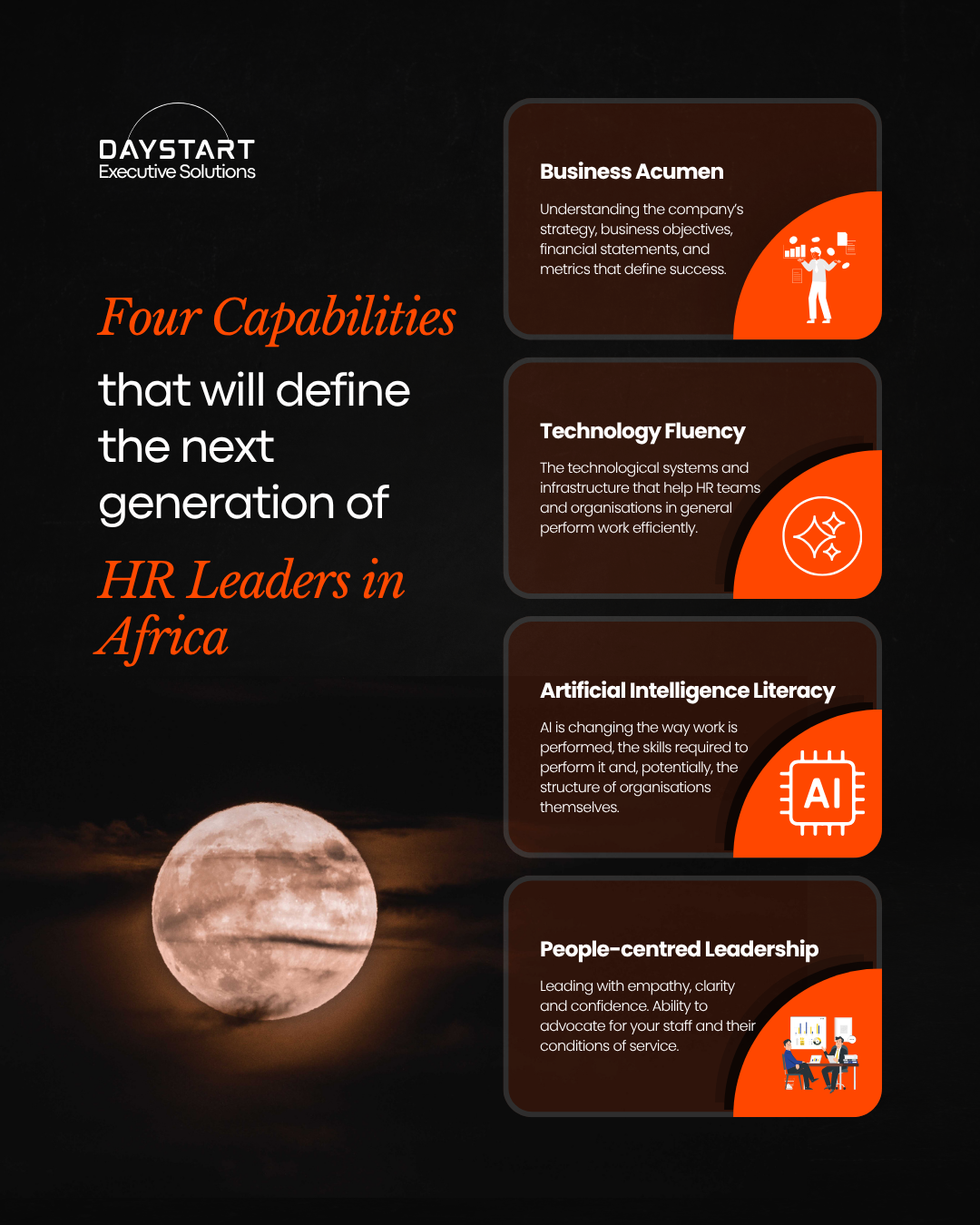
The next generation of HR leaders will need to develop four interconnected capabilities: business acumen, technology fluency, artificial intelligence literacy, and people-centred leadership.
These are not substitutes for core HR knowledge. Rather, they are the capabilities that allow an HR professional to move from being an effective HR practitioner to becoming a strategic leader of people and organisations.
1. Business Acumen: Understanding the Business Before Advising the Business
The foundation of strategic HR leadership is business acumen.
An HR professional cannot provide strategic advice about people without first understanding what the organisation is trying to achieve, how it creates value, what determines its financial performance and which capabilities are required to execute its strategy.
This sounds obvious, yet it is one of the most significant differences between operational and strategic HR.
An operational HR professional may receive a request to recruit 20 employees and begin working on job descriptions, advertising, sourcing and interviews. A strategically oriented HR leader begins by asking why the organisation needs those 20 employees, what business objective they are intended to support, whether the required capability exists internally, whether the proposed structure is sustainable and what the additional workforce will mean for the organisation's cost base.
The distinction is not about whether one person performs recruitment better than the other. It is about the level at which the HR professional understands the problem.
The first professional is responding to a workforce requirement.
The second is interrogating the business requirement behind it.
That is business acumen.
Understanding strategy and translating it into people implications
Strategic HR leaders need to understand the organisation's strategy in sufficient detail to identify its implications for the workforce.
Consider an organisation pursuing an aggressive growth strategy. Its stated objective might be to increase revenue by expanding into new geographic markets. That objective has implications for sales capacity, operational infrastructure, management capability, customer service, finance, technology and leadership.
For HR, the implications may include workforce planning, recruitment, succession planning, leadership development, organisational design, compensation and benefits, employee mobility and performance management.
Alternatively, consider a business pursuing a cost-leadership strategy. The HR implications could be substantially different. The organisation may need to examine spans and layers, workforce productivity, overtime, role duplication, operating structures, automation opportunities, reward structures and potentially restructuring.
A business strategy does not become an HR strategy simply because HR creates a list of HR activities.
The HR leader has to understand the business objective first and then determine what must happen to the workforce, organisation and leadership system for that objective to be achieved.
This is why workforce planning should not be treated simply as forecasting how many employees the organisation will need next year. Increasingly, it is about understanding what capabilities the organisation will need, where those capabilities will come from and how the workforce model should evolve as the business changes.
McKinsey's 2026 HR research similarly argues that workforce planning must move from predominantly operational capacity planning towards forward-looking, task- and capability-based planning.
For an African organisation facing expansion, digitalisation or restructuring, that distinction can be particularly important. The question may not be, "How many employees should we hire?" It may be, "What combination of people, technology, skills and organisational structures will allow us to achieve our strategy at an acceptable cost?"
That is a much more strategic HR question.
Financial literacy is part of HR leadership
Business acumen also requires financial literacy.
An HR leader does not need to be an accountant or financial analyst, but should be sufficiently comfortable with financial statements and management reports to understand how people decisions affect business performance.
Revenue, gross margin, operating expenses, cash flow, labour costs, productivity, budget variance and profitability should not be foreign concepts to senior HR professionals.
Suppose a company is experiencing declining margins despite increasing revenue. An HR leader who understands the business should recognise that the issue may have implications for labour productivity, workforce structure, compensation, overtime, organisational efficiency and the allocation of critical skills.
If management decides to reduce operating expenditure, HR should be able to distinguish between a simple headcount-reduction exercise and a broader cost-transformation programme.
The latter could involve organisational redesign, process improvement, technology adoption, centralisation of functions, job redesign, workforce redeployment, changes to spans and layers, or restructuring.
The quality of HR's response depends on its understanding of the financial and operational problem.
This is why financial literacy should be regarded as part of the professional development of the modern HR leader rather than a capability belonging exclusively to finance.
Metrics connect HR to business performance
A third dimension of business acumen is understanding metrics.
Strategic HR leaders need to understand the metrics used by the organisation to measure performance and then identify the people-related indicators that influence those outcomes.
If the business is focused on revenue growth, the relevant HR questions might concern sales capacity, productivity, critical talent availability and incentive design.
If the organisation's priority is customer experience, HR may need to examine staffing levels, capability, employee engagement, frontline performance and manager effectiveness.
If the business is focused on operational efficiency, workforce productivity, absenteeism, overtime, turnover in critical roles and process capability may become more important.
This also changes how HR should approach its own metrics.
Headcount, turnover, absenteeism, time to hire and training expenditure are useful measures, but they become strategically meaningful only when HR can connect them to business outcomes.
A high turnover rate is not automatically a business crisis. High turnover among employees in roles that are difficult to replace, directly linked to revenue or essential to operational continuity may be.
Similarly, a reduction in training expenditure may appear favourable from a cost perspective while creating a capability gap that undermines the organisation's strategy.
Strategic HR therefore asks not only, "What is the HR metric?" but also, "What does this metric mean for the business?"
That ability to connect people data to business performance is one of the clearest markers of strategic HR maturity.
2. Technology Fluency: HR Can No Longer Delegate Digital Understanding
Business acumen allows HR to understand what the organisation is trying to achieve. Technology fluency helps HR understand how the organisation can work differently to achieve it.
For many years, technology was treated as the responsibility of the IT function. HR professionals were expected to understand their own processes while IT professionals managed systems and digital infrastructure.
That boundary is increasingly difficult to maintain.
Technology now affects recruitment, onboarding, payroll, performance management, learning and development, employee engagement, workforce analytics, internal communication and employee experience. HR professionals who do not understand the technology supporting these processes risk becoming dependent on other functions for decisions that directly affect their own area of responsibility.
Technology fluency does not mean that HR leaders need to become software engineers.
It means they need sufficient knowledge to understand the systems they use, evaluate technology solutions, interpret digital information and identify opportunities for automation and process improvement.
HRIS should be fundamental knowledge
Human Resource Information Systems, or HRIS, are an important starting point.
An HRIS can provide the infrastructure for managing employee information, recruitment, onboarding, leave, performance, compensation, learning and other aspects of the employee lifecycle.
However, HRIS knowledge should extend beyond knowing how to enter information into a system.
An HR leader should understand how HR data is structured, how different systems integrate, what reports can be generated, what information management requires and what controls are necessary to protect employee data.
For example, if an organisation has high turnover, an HRIS should enable HR to examine turnover by department, location, role, tenure, manager and other relevant variables.
The system provides the data.
The HR professional provides the interpretation.
That distinction is fundamental.
Technology does not make HR strategic by itself. It creates the infrastructure through which strategic HR becomes more possible.
From digital administration to people analytics
The next step is people analytics.
As organisations accumulate more workforce data, HR has an opportunity to move from descriptive reporting towards evidence-based decision-making.
Instead of simply reporting that turnover increased from 12% to 17%, HR can examine where the increase occurred, which employee groups are affected, whether the movement is concentrated in critical roles and what business consequences may follow.
Instead of reporting training participation, HR can examine whether employees who completed a capability programme demonstrated measurable changes in performance.
Instead of reporting recruitment volumes, HR can examine quality of hire, time to productivity, source effectiveness and critical-role vacancy costs.
This requires HR professionals to become more comfortable with data.
The strategic HR leader does not necessarily need to be a data scientist, but must be capable of asking better questions of data and using evidence to support decisions.
Technology fluency therefore strengthens business acumen. The two capabilities increasingly operate together.
3. Artificial Intelligence: Understanding How Work Itself Is Changing
Artificial intelligence deserves separate treatment from general technology fluency because its implications extend beyond the automation of HR processes.
AI is changing the way work is performed, the skills required to perform it and, potentially, the structure of organisations themselves.
That makes AI a strategic HR issue.
McKinsey's recent work on HR's role in the AI era describes a dual mandate: HR must transform its own function while helping the wider organisation redesign roles, workflows, capabilities and workforce structures for human-AI collaboration.
BCG similarly argues that the CHRO is increasingly becoming an architect of the hybrid workforce, with responsibilities extending into organisation design, skills planning, change management and AI governance.
For African HR professionals, the implications are substantial.
Africa has significant potential to capture value from AI, but capability and infrastructure remain important constraints. McKinsey's research across African organisations found that more than 40% of surveyed institutions had begun experimenting with or implementing significant generative AI solutions, while also identifying infrastructure, skills and regulatory uncertainty among the barriers to scaling.
The emerging HR professional therefore needs more than basic awareness of AI tools.
They need AI literacy.
HR professionals need to understand automation and augmentation
The first question is whether AI can automate a task.
The second, more important question is whether the task should be automated.
Recruitment provides a useful example. AI can support CV screening, interview scheduling, job-description drafting and candidate communication. But an HR leader must still consider bias, candidate experience, data privacy, decision accountability and the appropriate role of human judgement.
The same principle applies to performance management, employee relations and workforce analytics.
AI can generate information and recommendations. HR leaders remain responsible for determining how those outputs should influence decisions.
This requires HR professionals to understand both the capabilities and limitations of AI.
AI also changes workforce planning
The implications become much larger when AI moves beyond individual tasks.
Suppose a customer-service function introduces AI that handles a significant proportion of routine enquiries. The question for HR is no longer simply whether to provide employees with an AI tool.
HR must consider how the operating model changes.
Does the organisation need fewer frontline employees?
Do existing employees need new skills?
Will the remaining employees handle more complex cases?
Will quality assurance requirements change?
Will new AI governance roles emerge?
How will performance be measured?
What happens to career progression if entry-level employees are no longer performing the routine work through which they traditionally gained experience?
These are workforce-planning and organisation-design questions.
They demonstrate why AI competence is becoming a leadership capability rather than merely a digital skill.
4. People-Centred Leadership: Keeping the Human Dimension at the Centre
Business acumen, technology fluency and AI literacy can make HR considerably more strategically capable. They do not, however, answer the question of how HR should lead people through organisational change.
That requires people-centred leadership.
People-centred leadership does not mean placing employee preferences above business requirements. Nor does it mean avoiding difficult decisions in the name of empathy.
It means recognising that sustainable organisational performance depends on understanding the people who create it.
For HR leaders, this requires at least three important capabilities: empathy, people advocacy, and the ability to lead with clarity and confidence.
Leading with empathy
Empathy allows HR leaders to understand the human context behind organisational behaviour.
When an employee's performance deteriorates, the appropriate response may be performance management. But before determining the response, the HR leader should understand whether the underlying issue is capability, workload, management, wellbeing, role clarity, motivation or another factor.
Empathy does not remove accountability.
It improves the quality of judgement.
This is especially important in environments where employees may face pressures outside the workplace that affect their ability to perform. African organisations operate within diverse social and economic contexts, and HR leadership needs to account for those realities without compromising professional standards.
The strongest HR leaders can hold two ideas simultaneously: employees should be accountable for their performance, and leaders should understand the conditions under which that performance is taking place.
People advocacy is a strategic responsibility
The HR function occupies a distinctive position in an organisation because it has responsibility for both organisational effectiveness and the employee experience.
This creates a responsibility to ensure that employee realities are represented in leadership decisions.
Consider an organisation operating in Accra during periods of severe rainfall and associated transport disruption. Employees may struggle to reach the workplace safely or may spend several additional hours commuting. A rigid application of attendance requirements may satisfy a policy while undermining productivity and employee trust.
A people-centred HR leader would assess whether flexible working, adjusted reporting times or temporary remote work could preserve business continuity while addressing the circumstances employees are experiencing.
This is not about HR automatically siding with employees.
It is about HR bringing relevant employee realities into the business decision.
The same principle applies to organisational restructuring, compensation decisions, changes in working arrangements and the introduction of new technology.
People advocacy is not the opposite of commercial thinking.
Done well, it is part of commercial thinking because employee experience, trust, retention, productivity and organisational reputation can all influence business performance.
Leading with clarity and confidence
The final element is the ability to communicate and lead through uncertainty.
HR leaders frequently become the point of reference when organisations undergo difficult changes. Employees want to understand what is happening, why decisions are being made, what the implications are and what they should expect next.
In such circumstances, ambiguity from HR can magnify uncertainty.
Clarity therefore becomes a leadership capability.
The HR leader needs to communicate difficult information honestly, explain the rationale behind decisions and distinguish what is known from what remains uncertain.
Confidence is equally important.
Strategic HR professionals will sometimes have to challenge senior leaders. They may need to question an unrealistic workforce plan, recommend changes to a proposed structure, raise concerns about employee impact or challenge a decision that creates unnecessary organisational risk.
That requires more than technical HR knowledge.
It requires professional judgement and the confidence to exercise it.
The strategic HR leader is neither an employee representative who simply opposes management nor a management representative who simply communicates management decisions.
The role is more sophisticated.
HR must help leadership understand the consequences of its decisions for people while helping employees understand the realities and requirements of the business.
That is the essence of people-centred leadership.
The Four Capabilities Are Most Powerful When Combined
These capabilities should not be developed independently.
Their strategic value comes from the way they reinforce one another.
Consider an organisation that is preparing for significant expansion.
Business acumen enables the HR leader to understand the growth strategy, financial objectives and operating model.
Workforce planning then translates those business requirements into talent demand, capability requirements and organisational implications.
Technology fluency allows HR to determine how HRIS, people analytics and digital workflows can support the expanded organisation.
AI literacy enables HR to identify where automation and augmentation could improve productivity and where new skills or roles may be required.
People-centred leadership ensures that employees are prepared for the transition, managers are equipped to lead the change, and employee concerns are appropriately represented in the process.
The same framework applies to restructuring.
A strategically capable HR leader does not begin with a list of positions to eliminate. The starting point is the business problem.
What is driving the restructuring?
What operating model is the organisation moving towards?
Which capabilities are critical to the future model?
Which roles will change?
Which capabilities can be developed?
Which employees can be redeployed?
Where is external hiring necessary?
What are the legal, financial and employee-relations implications?
How should the change be communicated?
How should the organisation support affected employees?
The quality of the restructuring process depends on HR's ability to connect business strategy, workforce planning, organisation design, technology, change management and employee experience.
That is why strategic HR is not simply a more senior version of operational HR.
It is a different way of thinking.
What This Means for Emerging HR Professionals in Africa
For young HR professionals entering the field, the implication is straightforward: do not build your career exclusively around mastering HR processes.
Core HR knowledge remains essential. An HR professional should understand recruitment and selection, employee relations, compensation and benefits, performance management, learning and development, employment law, organisational development and HR operations.
But these should be the foundation, not the ceiling.
An emerging HR professional should also learn to read a financial statement, interpret a business plan, understand an organisation's operating model and identify the metrics that determine business performance.
They should become comfortable with HRIS platforms and people analytics.
They should develop practical AI literacy and understand how automation may affect jobs, workflows and organisational structures.
They should learn how to conduct workforce planning and participate in organisation-design discussions.
They should develop the confidence to present an HR business case to senior leadership.
And they should develop the emotional intelligence required to lead employees through difficult organisational circumstances.
This is particularly important because the traditional career path through HR is itself changing.
AI and automation are increasingly affecting routine administrative work. McKinsey's 2026 research on talent development notes that activities such as research, documentation, data preparation and preliminary analysis have historically provided entry-level employees with opportunities to develop professional judgement, but these activities are increasingly being streamlined or absorbed by AI.
That creates an important challenge for emerging HR professionals.
The profession cannot simply expect young practitioners to learn through routine administration indefinitely.
They will need earlier exposure to business strategy, analytics, technology, workforce planning and organisational decision-making.
For HR leaders responsible for developing the next generation, this means deliberately creating opportunities for junior professionals to participate in business reviews, workforce planning exercises, organisational-design projects, HR analytics and transformation initiatives.
The future HR leader needs exposure to the business much earlier in their career.
From HR Practitioner to Strategic HR Leader
The distinction between operational and strategic HR should not be understood as a distinction between junior and senior employees.
A senior HR professional can remain operationally focused, while a relatively young HR professional can demonstrate strategic thinking.
The difference lies in the questions they ask.
An operational HR practitioner may ask, "What policy applies?"
A strategic HR professional also asks, "What business outcome are we trying to achieve, and is this policy helping us achieve it?"
An operational practitioner may ask, "How many people do we need to hire?"
A strategic practitioner asks, "What capabilities do we need, what is the most effective workforce model, and how should we build or acquire those capabilities?"
An operational practitioner may ask, "How do we implement this technology?"
A strategic practitioner asks, "How will this technology change the work, skills, roles and organisational structure?"
An operational practitioner may ask, "How do we communicate this decision?"
A strategic people leader asks, "What will this decision mean for employees, managers, culture, performance and trust, and how should we lead the organisation through it?"
The difference is not the abandonment of HR operations.
It is the ability to see beyond them.
The Future of HR Leadership in Africa
Africa does not need an HR profession that simply replicates models developed in other markets. It needs HR leaders capable of applying global management thinking to the realities of African organisations and labour markets.
That requires commercial understanding, technological capability, AI literacy and a strong understanding of people.
The opportunity is significant.
African organisations are operating in markets where digital transformation, workforce development and productivity improvement are increasingly important. McKinsey estimates that generative AI alone could create substantial economic value across African economies, while BCG highlights the continent's need to strengthen AI talent and digital capabilities.
HR has an important role in determining whether that opportunity translates into organisational capability.
The strategic HR leader will be the person who can understand the business case for transformation, determine its workforce implications, identify the capabilities required, use technology and AI intelligently, and lead people through the resulting change.
That is a considerably broader mandate than administering HR.
It is also a more consequential one.
The next generation of African HR leaders therefore has an opportunity to redefine what the profession means within the organisation. The objective should not simply be to secure HR a permanent place at the executive table. The objective should be to ensure that when HR is at that table, it has the business knowledge, analytical capability, technological fluency and leadership judgement required to influence decisions that determine organisational performance.
The HR leaders who develop these capabilities will be positioned not merely to manage the workforce, but to help shape the organisation itself.
That is where the profession is heading.
And for Africa's emerging HR leaders, preparing for that future should begin now.